
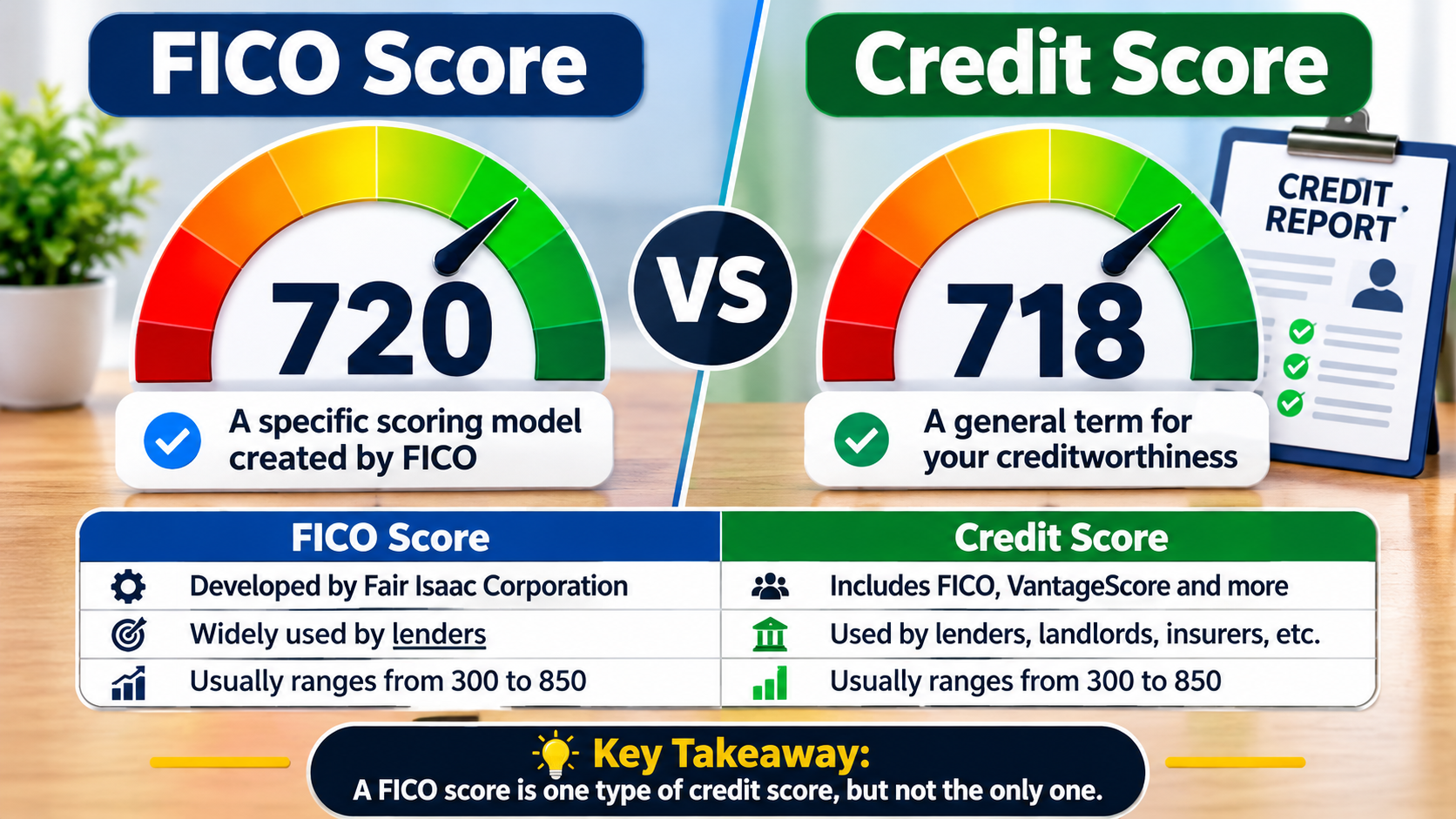
When you apply for a credit card, mortgage, auto loan, or personal loan, lenders often review your credit score to understand how responsibly you manage borrowed money. While checking your financial information, you may come across terms such as FICO Score, credit score, and VantageScore. These terms are closely related, but they do not all mean exactly the same thing. A FICO score is a type of credit score, but not every credit score is a FICO score. FICO is a credit scoring company that developed its own models to calculate credit scores using information from consumer credit reports. Other companies, including VantageScore, also create scoring models that evaluate creditworthiness. Understanding the difference can help you interpret the number you see through your bank, credit card provider, or credit monitoring service. It can also help you avoid confusion when a lender reports a different score during a loan application. Is a FICO Score the Same as a Credit Score? No, a FICO score and a credit score are not exactly the same. A credit score is a general term for a numerical rating that estimates how likely someone is to repay borrowed money as agreed. A FICO score is one specific type of credit score calculated using FICO’s scoring models. Think of credit score as the overall category and FICO as one brand within that category. Other scoring companies use their own formulas and may produce different results from the same credit report information. For example, you might see a FICO score of 710 through one service and a VantageScore of 725 through another. Both numbers represent credit scores, but they are calculated using different models and may use information from different credit bureaus. The main difference Feature FICO Score General Credit Score Meaning A specific branded credit score A broad term for credit scores Company Fair Isaac Corporation Different scoring companies Calculation FICO scoring algorithms Depends on the scoring model Data source Experian, Equifax, or TransUnion credit information Credit bureau information Score range Most base scores use 300–850 Many use 300–850, but ranges can differ Lender usage Widely used by lenders Depends on the scoring model The important point is that all FICO scores are credit scores, but other credit scores may come from completely different scoring systems. What Is a FICO Score? A FICO score is a three-digit number developed by Fair Isaac Corporation. It helps lenders estimate the likelihood that a consumer will repay a loan or credit obligation on time. FICO introduced its credit scoring system in 1989. Since then, it has developed several scoring models designed for different lending situations. Most standard FICO scores range from 300 to 850. Generally, a higher score indicates a stronger credit profile and may help you qualify for better borrowing terms. Why lenders use FICO scores Banks, mortgage companies, credit card issuers, and auto lenders use credit scores to evaluate applications. FICO scores are widely used because they provide a consistent way to assess credit risk. A lender may use a FICO score to help determine: However, lenders do not rely on FICO scores alone. They may also review income, employment, outstanding debt, payment history, and other application details. Are all FICO scores the same? No. FICO has multiple scoring versions, and each may evaluate credit information differently. For example, FICO Score 8 is a widely used general-purpose version. Other models are designed for specific lending products, including auto loans and credit cards. This means you can have several different FICO scores at the same time. The number may vary depending on the credit bureau, scoring version, and date when the score is calculated. What Is a Credit Score? A credit score is a numerical estimate of how likely you are to repay borrowed money. It is calculated using information from your credit report, including your payment history, outstanding balances, credit utilization, and account history. Credit scores help financial institutions make lending decisions. A higher score generally suggests lower credit risk, while a lower score may indicate a greater likelihood of missed payments or other repayment difficulties. How credit scores are calculated Different scoring companies use different formulas. However, most consumer credit scoring models consider several common factors: Your credit score can change when new information is reported to the credit bureaus. For example, paying down a credit card balance or missing a loan payment may affect your score after the information is updated. Why you have more than one credit score There is no single credit score that every lender uses. Your score may differ because different companies use different scoring formulas, credit bureaus provide different information, and scoring models may be updated at different times. For example, a mortgage lender may use a particular FICO model, while a credit monitoring website may display a VantageScore. Both are legitimate credit scores, but they may not produce the same number. FICO Score vs. VantageScore: What Is the Difference? FICO and VantageScore are two major credit scoring systems used in the United States. Both evaluate information from credit reports, but they use different algorithms and may consider certain credit behaviors differently. FICO was developed by Fair Isaac Corporation. VantageScore was introduced in 2006 by the three major credit reporting companies: Experian, Equifax, and TransUnion. Both models are designed to help lenders estimate credit risk. However, the score you receive from one model may differ from the score calculated by the other. FICO credit score ranges Most standard FICO scores use the following categories: FICO Score Range Credit Rating 300–579 Poor 580–669 Fair 670–739 Good 740–799 Very Good 800–850 Exceptional VantageScore credit score ranges VantageScore 3.0 and 4.0 use these general categories: VantageScore Range Credit Rating 300–600 Subprime 601–660 Near Prime 661–780 Prime 781–850 Superprime Notice that the categories are different. A score of 670, for example, falls into the good category under FICO and the prime category under VantageScore. This is why it is important to know which scoring model is being used before deciding whether your score is