
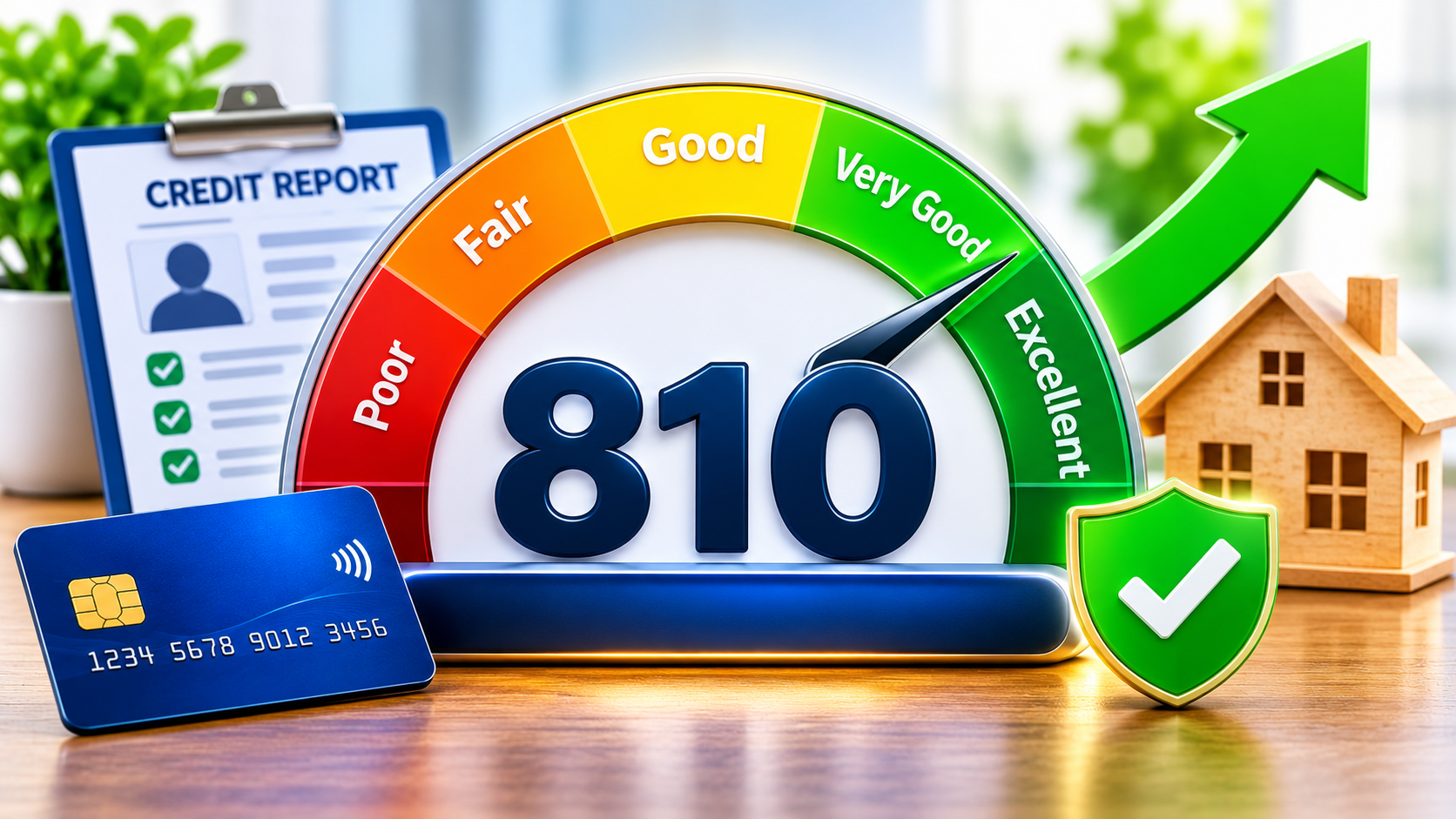
A credit score is one of the most important numbers lenders consider when evaluating your financial reliability. Whether you want to apply for a premium credit card, purchase a car, qualify for a mortgage, or obtain a personal loan, your credit score can influence your approval chances and borrowing costs. If your current score is 810, you are already in a very strong financial position from a credit-scoring perspective.
An 810 credit score is considered exceptional under the standard FICO scoring model and excellent under VantageScore. It places you in the highest FICO credit category and indicates that you have demonstrated responsible credit management over time. Consumers with scores at this level generally have a strong history of handling credit obligations.
An 810 score may help you qualify for competitive interest rates, premium credit cards, and favorable loan terms. However, having an exceptional score does not guarantee approval or the lowest possible interest rate. Lenders also evaluate income, existing debt, employment, and other financial information.
Is an 810 Credit Score Good?
Yes, an 810 credit score is excellent. Under the standard FICO model, scores of 800 and above fall into the exceptional category. This is the highest general-purpose FICO credit rating.
Lenders generally view borrowers with exceptional scores as lower-risk applicants because their credit histories often demonstrate consistent payments and responsible borrowing habits.
With an 810 score, you may have access to a wide range of financial products, including premium credit cards, competitive auto loans, conventional mortgages, and personal loans.
Understanding FICO credit score ranges
The following table explains the commonly used FICO credit score categories:
| FICO Credit Score | Rating |
| 300–579 | Poor |
| 580–669 | Fair |
| 670–739 | Good |
| 740–799 | Very Good |
| 800–850 | Exceptional |
An 810 score is comfortably within the exceptional category. You are 40 points away from the maximum possible FICO score of 850.
What does 810 mean under VantageScore?
VantageScore 3.0 and 4.0 also use a 300–850 scoring scale, but their rating categories are different.
| VantageScore Range | Rating |
| 300–600 | Subprime |
| 601–660 | Near Prime |
| 661–780 | Prime |
| 781–850 | Superprime |
Under VantageScore, an 810 score falls into the superprime category. Therefore, whether you are checking FICO or VantageScore, 810 represents an excellent credit position.
How Does an 810 Credit Score Compare With the National Average?
An 810 FICO score is significantly higher than the average credit score in the United States. According to FICO’s Fall 2026 Credit Insights report, the average U.S. FICO score was 714.
This means an 810 score is 96 points above the national average. It also places you in a credit category that demonstrates a strong record of financial responsibility.
Why the national average matters
Comparing your score with the national average helps you understand your general position among U.S. consumers. However, lenders do not approve applications simply because your score is above the average.
For example, someone with an 810 score may receive a favorable loan offer, but a lender can still consider their income, debt-to-income ratio, loan amount, and employment situation.
Your score is an important advantage, but maintaining a healthy overall financial profile remains essential.
Can You Get a Credit Card With an 810 Credit Score?
Yes, an 810 credit score can make you a strong candidate for many credit cards. You may qualify for premium rewards cards, travel credit cards, cashback products, and cards with attractive introductory offers.
Credit card issuers generally consider applicants with exceptional credit to be lower-risk customers. This can increase your chances of qualifying for products with valuable benefits.
Credit card options you may consider
With an 810 score, you can explore several types of credit cards:
- Premium travel credit cards: These may offer airport lounge access, travel insurance, points, and other travel-related benefits.
- Cashback credit cards: These provide rewards on everyday purchases such as groceries, dining, and fuel.
- Flexible rewards cards: These allow you to earn points that can be redeemed for different purchases or travel expenses.
- Balance transfer cards: Certain issuers offer promotional interest rates for eligible balance transfers.
- High-limit credit cards: Your strong credit history may support applications for cards with higher credit limits, depending on income and issuer requirements.
How to choose the right credit card
A high credit score does not mean you should apply for every premium card available. Compare annual fees, rewards structures, interest rates, and eligibility requirements.
If a card charges a substantial annual fee, make sure its benefits provide enough value to justify the cost. You should also avoid unnecessary applications because hard inquiries can temporarily affect your credit score.
Can You Buy a House With an 810 Credit Score?
Yes, an 810 credit score can put you in a strong position when applying for a mortgage. It is well above the minimum credit requirements for many conventional and government-backed mortgage programs.
A high score may improve your chances of qualifying for competitive mortgage pricing. However, the actual interest rate depends on several factors, including the loan type, down payment, property details, debt-to-income ratio, and lender requirements.
Conventional mortgage loans
Conventional mortgages are offered by private lenders and generally follow guidelines established by Fannie Mae and Freddie Mac.
An 810 score is significantly above common minimum credit requirements for many conventional loan products. This may help you qualify for favorable terms, depending on the rest of your financial profile.
FHA mortgage loans
FHA loans are backed by the Federal Housing Administration and are designed to make homeownership more accessible.
Under standard FHA guidelines, borrowers with qualifying scores of 580 or higher may be eligible for a down payment as low as 3.5%. Borrowers with scores between 500 and 579 generally need a down payment of at least 10%.
With an 810 score, you are well above these commonly cited thresholds. However, FHA loans also involve mortgage insurance, lender requirements, and other eligibility conditions.
How to make the most of your credit score
If you are planning to purchase a home, compare mortgage offers from several lenders. Even with exceptional credit, different lenders may offer different interest rates, fees, and closing costs.
Review the annual percentage rate, total loan expenses, and repayment terms instead of focusing only on the advertised interest rate.
Is an 810 Credit Score Good for a Car Loan?
Yes, an 810 credit score is excellent for an auto loan application. It may help you qualify for some of the most competitive financing offers available to eligible borrowers.
Auto lenders generally evaluate credit scores to estimate repayment risk. Applicants with exceptional credit may receive more attractive interest rates than borrowers with fair or poor credit.
However, auto lenders may use specialized scoring models such as FICO Auto Scores. These models can differ from the general FICO score you see through a credit card company or monitoring service.
Benefits of an 810 score when financing a car
A strong credit profile may provide several advantages:
- Better chances of qualifying for competitive interest rates
- Access to financing offers from multiple lenders
- Potential eligibility for promotional financing programs
- More flexibility when comparing loan terms
- Stronger negotiating position when discussing financing
What else affects auto loan approval?
Even with an 810 score, lenders may evaluate your monthly income, existing debt, employment stability, vehicle price, down payment, and requested repayment period.
A high score cannot guarantee approval if the loan amount is too large compared with your financial capacity.
Before purchasing a vehicle, consider getting prequalified through a bank or credit union and compare its offer with dealership financing.
What Interest Rates Can You Expect With an 810 Credit Score?
An 810 credit score may help you qualify for highly competitive interest rates, but there is no fixed rate associated with this number.
Your actual rate depends on the type of credit product, lender, market conditions, loan amount, repayment period, and other financial details.
For example, a mortgage lender may offer different pricing based on your down payment and debt-to-income ratio, even when your credit score is excellent.
Factors that influence your borrowing costs
Payment history: A consistent record of paying bills on time can strengthen your application and demonstrate responsible credit management.
Credit utilization: Lenders and scoring models consider your outstanding credit card balances relative to your available limits. Lower utilization generally supports a healthy credit profile.
Debt-to-income ratio: This measures your monthly debt obligations against your gross monthly income. A lower ratio can make your application more attractive.
Loan amount: Borrowing a large amount may increase the lender’s exposure and influence the available terms.
Repayment period: A longer loan term may reduce monthly payments but can increase the total interest paid over time.
Lender requirements: Financial institutions have different underwriting policies and interest-rate structures. Comparing offers can help you find suitable terms.
What Factors Help Maintain an 810 Credit Score?
An exceptional credit score usually reflects a long history of responsible credit management. FICO considers several categories when calculating its standard credit scores.
Understanding these categories can help you maintain your current score and avoid financial habits that could cause it to decline.
1. Payment history
Payment history accounts for approximately 35% of a typical FICO score. It is the most influential scoring category.
A strong payment history shows that you consistently meet your credit obligations. Late payments, collections, and serious delinquencies can damage your score.
Continue paying credit cards, mortgages, auto loans, and other reported accounts by their due dates. Automatic payments can help prevent accidental missed payments.
2. Credit utilization
Amounts owed account for approximately 30% of a typical FICO score. Credit utilization measures how much of your available revolving credit you are using.
For example, if your total credit card limit is $20,000 and your outstanding balance is $2,000, your utilization is 10%.
Lower utilization is generally better. Paying balances before they become too high can help maintain a strong credit profile.
You do not need to carry a balance or pay interest to maintain a high score.
3. Length of credit history
The length of your credit history accounts for approximately 15% of a typical FICO score.
Older accounts can demonstrate a longer record of managing credit responsibly. Avoid closing older accounts without considering how doing so may affect your available credit and overall profile.
4. New credit
New credit accounts for approximately 10% of a typical FICO score. This category considers recent credit applications and newly opened accounts.
Even with an 810 score, several hard inquiries within a short period may temporarily lower your score.
Apply for new credit when it provides a genuine financial benefit rather than opening accounts unnecessarily.
5. Credit mix
Credit mix accounts for approximately 10% of a typical FICO score. It considers the different types of credit you manage, such as credit cards, mortgages, and installment loans.
A variety of account types may contribute positively to your credit profile. However, you should not borrow money simply to create a different credit mix.
How Can You Maintain an 810 Credit Score?
Once your score reaches 810, the goal should be to maintain your strong credit history rather than constantly trying to increase the number.
A few consistent financial habits can help protect your credit profile.
Pay every bill on time
Continue making payments by their due dates. Payment history is a major part of FICO scoring, and even a single late payment may affect an otherwise strong profile.
Set up automatic payments or reminders for your important bills.
Keep credit card balances manageable
Avoid allowing outstanding balances to grow unnecessarily. Lower utilization can help support your credit score.
If you use credit cards regularly, consider paying the statement balance in full each month to avoid interest charges.
Limit unnecessary hard inquiries
Avoid applying for several credit cards or loans simply because you are eligible. Each hard inquiry may temporarily affect your score.
Research products carefully and use prequalification options when available.
Review your credit reports regularly
Check your reports from Experian, Equifax, and TransUnion. Look for unfamiliar accounts, inaccurate balances, incorrect payment records, or other suspicious activity.
You can access free credit reports through AnnualCreditReport.com. If you find inaccurate information, dispute it with the appropriate credit bureau and the company that reported it.
Protect your personal information
Identity theft and unauthorized credit applications can create problems even for consumers with excellent credit.
Use strong passwords, monitor financial accounts, and respond promptly to unfamiliar activity. Consider a credit freeze if you are concerned about someone opening accounts in your name.
Is It Worth Increasing an 810 Credit Score to 850?
An 810 score is already within the exceptional FICO category. Increasing it to 850 may be satisfying, but it is not usually necessary to qualify for competitive financial products.
The difference between 810 and 850 may not provide a meaningful advantage with many lenders because both scores are already in the highest general FICO category.
Why maintaining 810 may be enough
Many lenders reserve their most competitive offers for borrowers with strong credit profiles. An 810 score already places you in an excellent position to explore those offers.
Other factors, such as income, debt, down payment, and lender-specific requirements, may have a greater influence on your final borrowing terms.
Should you aim for 850?
If your goal is to reach the highest possible FICO score, continue maintaining excellent payment habits, low utilization, and a stable credit history.
However, do not open unnecessary accounts or take on debt just to gain a few additional points. Maintaining financial stability is more valuable than achieving a perfect score.
Conclusion
An 810 credit score is exceptional under FICO and superprime under VantageScore. It demonstrates a strong credit profile and may provide access to premium credit cards, competitive mortgage offers, and favorable auto loan terms. Your score is also significantly higher than the reported U.S. average FICO score of 714. However, excellent credit does not guarantee approval or the lowest available interest rate because lenders consider income, debt, employment, and other financial details. Focus on maintaining on-time payments, keeping credit utilization low, avoiding unnecessary applications, and monitoring your credit reports. With these habits, you can protect your excellent credit standing and continue enjoying the financial opportunities it may provide.
Frequently Asked Questions
1. Is an 810 credit score considered excellent?
Yes. An 810 FICO score falls into the exceptional category, which begins at 800. Under VantageScore 3.0 and 4.0, it is classified as superprime or excellent.
2. Can I get a mortgage with an 810 credit score?
Yes. An 810 score can make you a strong mortgage applicant. You may qualify for competitive mortgage options, although approval and interest rates also depend on income, debt-to-income ratio, down payment, property details, and lender requirements.
3. Can I get the best interest rates with an 810 credit score?
An 810 score may help you qualify for some of the most competitive interest rates available. However, lenders consider other financial factors, and the lowest rate is not guaranteed.
4. How rare is an 810 credit score?
An 810 score is relatively uncommon because it falls within the exceptional FICO category. It is substantially higher than the U.S. average FICO score, although the exact percentage of consumers with an 810 score changes over time.
5. Can an 810 credit score drop?
Yes. Even an exceptional score can decrease because of late payments, high credit utilization, new hard inquiries, account changes, or inaccurate information. Maintaining responsible credit habits can help protect your score.
| Read More: Is a FICO Score the Same as a Credit Score? |